" height="40.0000004693602px" id="JNsUwfViG" width="56px"/></svg>)
[
]
Confidential Computing for AI Workloads
Confidential computing protects AI data in execution, and ORGN enforces it with TEEs, zero retention, and verifiable attestation workflows
Security & Compliance
Standard encryption protects data on disks or in the wire, but fails when the CPU starts processing. Confidential computing fills this gap by isolating execution inside hardware-encrypted memory hidden from the host. This boundary prevents system admins or compromised hypervisors from scraping your info while it is active.
AI workflows leak data through tokenizers and caches before the model ever generates an output. Typical pipelines allow plaintext to slip into provider logs during these small, unprotected steps. A secure enclave keeps the full request lifecycle encrypted, so sensitive context never hits unencrypted RAM.
Securing the model endpoint is useless if the surrounding logic handles raw data in open system memory. ORGN protects the entire workspace, so preprocessing and retrieval share the same hardware-enforced isolation as inference. This removes the need to trust a provider software stack, relying instead on the physical CPU boundaries.
Real security requires technical proof rather than relying on legal contracts or marketing claims that cannot be audited. Remote attestation provides a cryptographic signature of the exact code and hardware identity before any data is shared. If the environment fails to match the expected measurement, the system blocks the connection to prevent exposure.
Isolation comes at a performance cost, with higher latency and tighter memory limits for models. Engineers must design paths that use confidential compute for sensitive data while keeping non-critical tasks on standard hardware.
Introduction
Confidential computing moved from research prototypes to production once hardware-backed isolation became stable enough for real workloads. Industry data shows this is not a niche shift; a Linux Foundation study reports that around 75 percent of organizations are already adopting confidential computing, with many running pilots or production deployments. At the same time, Gartner predicts that more than 75 percent of processing in untrusted infrastructure will be secured using confidential computing by 2029, driven by AI adoption and stricter data control requirements.
You see the same concern repeated in r/PromptEngineering and r/MachineLearning threads: engineers trust encryption at rest and TLS, but runtime still feels like a blind spot. Data gets decrypted somewhere, and that “somewhere” is usually outside their control. AI systems make this worse because prompts often contain internal documents, logs, or user data. Model outputs can also leak patterns or structure, and most hosted APIs still log requests in some form. That raises a simple question teams cannot ignore: who can see the memory while the model runs?
This article breaks down what confidential computing actually means at the execution layer, why AI workloads expose a gap that traditional security models do not cover, and how ORGN applies confidential computing across both model inference and full workspace execution to close that gap.
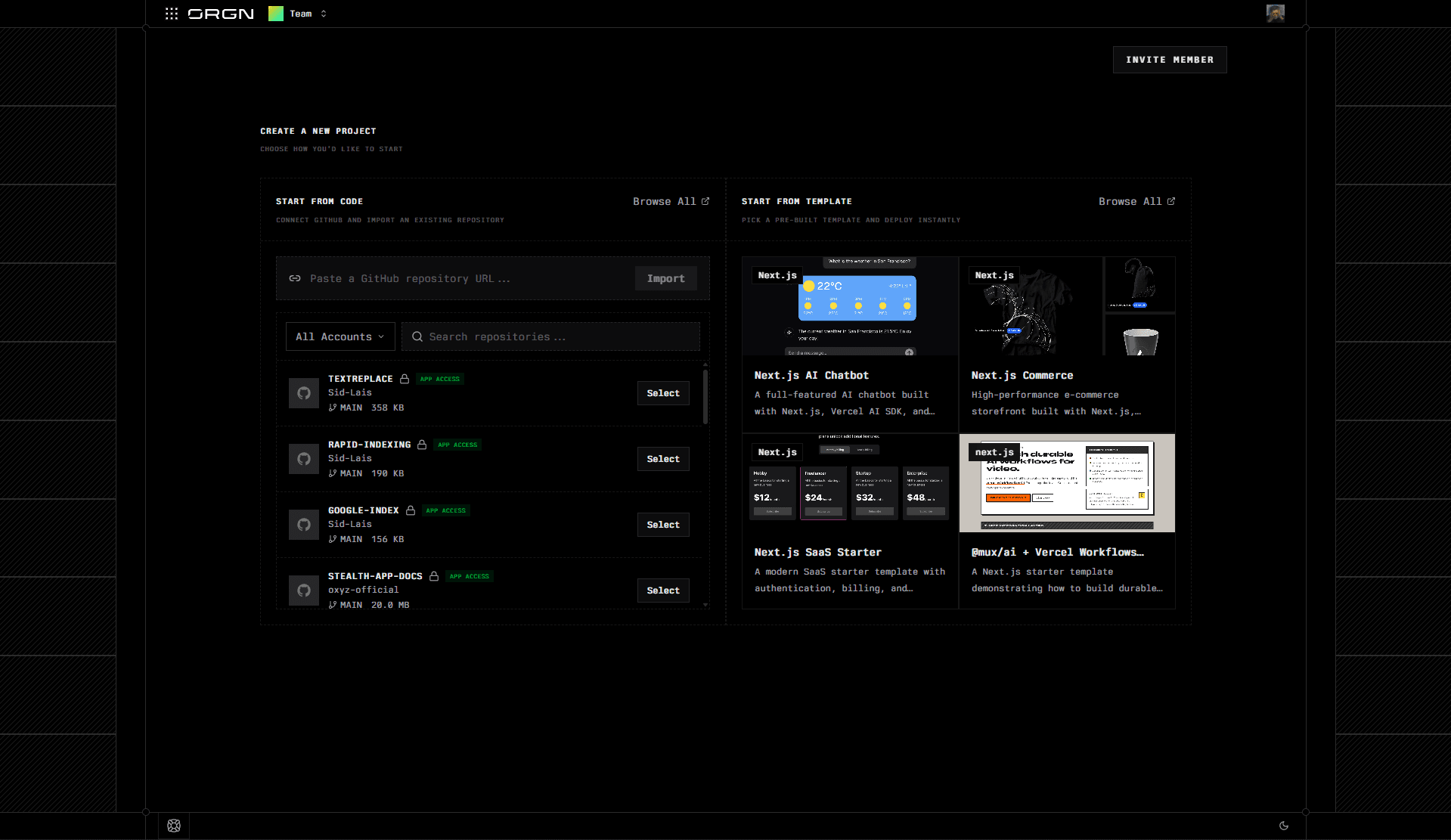
ORGN combines agent workflows, repositories, and secure execution inside a single controlled environment.
What Confidential Computing Means
Traditional security models cover two states well: data at rest and data in transit. Disk encryption protects stored data, and TLS secures communication between systems.
The third state, data in use, is where things break down. Once data is loaded into memory for processing, it becomes visible to the host operating system, hypervisor, and sometimes even debugging or monitoring tools.
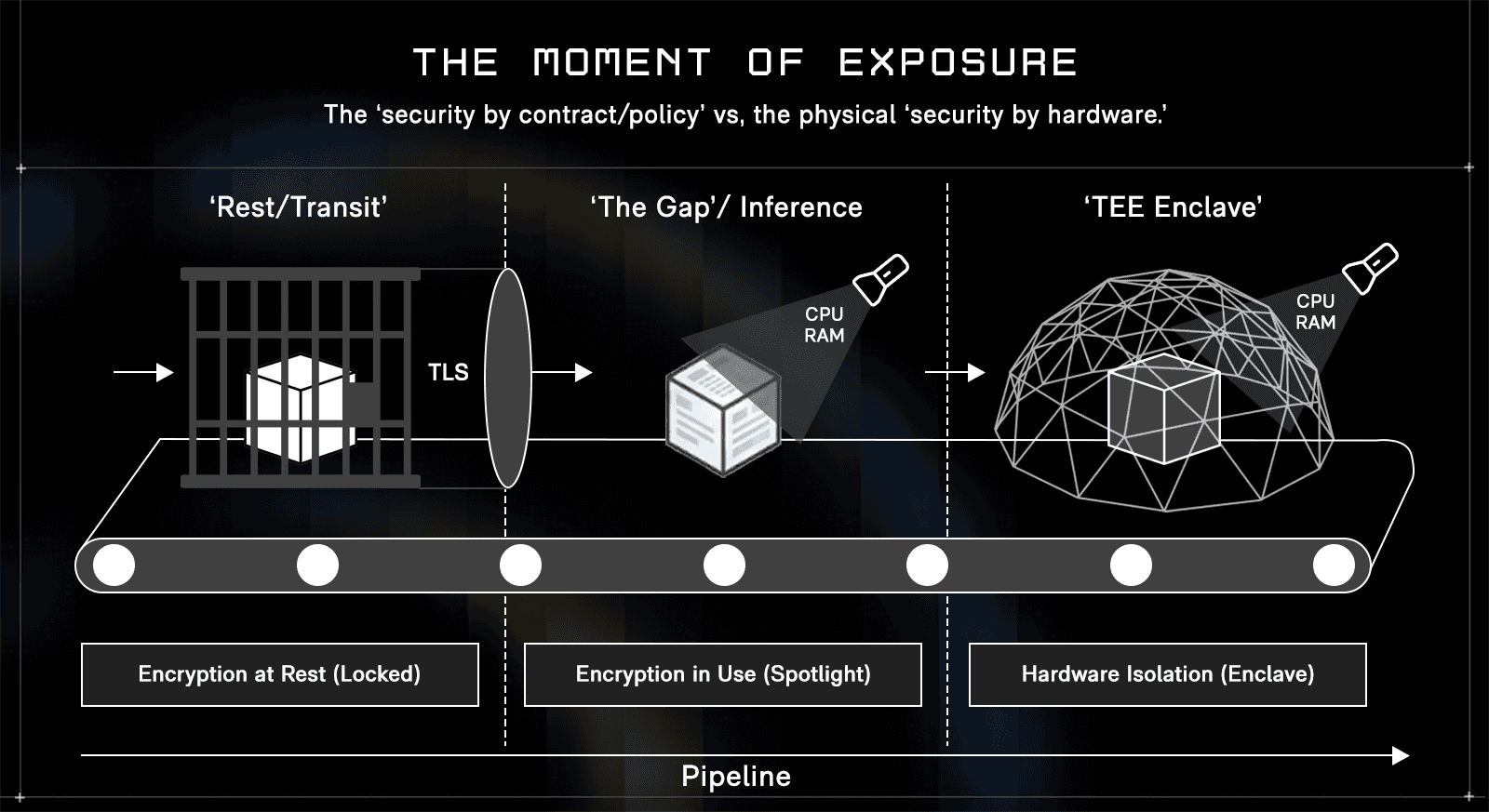
Confidential computing addresses this by isolating execution inside a Trusted Execution Environment, where memory is encrypted, and access is restricted at the CPU level. The workload runs normally, but anything outside the enclave cannot inspect or modify its state.
A simplified flow looks like this:
Client → Encrypted Input → TEE → Processing → Encrypted Output → Client |
The host machine still schedules and allocates resources, but it cannot see the data or the computation itself. That changes the trust model from “trust the platform” to “trust the hardware boundary.”
Why AI Workloads Break Traditional Security Models
AI pipelines rarely behave like clean request-response services. They pass data through multiple stages, often mixing preprocessing, embedding, retrieval, and generation in a single flow.
A minimal example already shows the issue:
prompt = f""" |
That internal_doc is not placeholder data. It is usually a contract, an incident report, or a customer export. TLS protects it during transport, but once the request reaches the model runtime, it sits in plaintext memory.
The problem grows once you look at real pipelines. Data gets tokenized, chunked, cached, and sometimes logged for debugging. Each step creates another place where plaintext exists, and most of those places sit outside the team’s control.
Take a retrieval-augmented workflow that pulls internal documents before calling the model:
query = "Summarize last quarter escalations" |
Here, sensitive data is stored in three places: the vector store, application memory, and the model runtime. Even if the vector store is encrypted and transport uses TLS, the runtime still exposes plaintext. Providers add another layer of uncertainty. Some retain prompts for debugging or quality checks, others claim not to, but still run internal observability systems. Engineers cannot inspect those systems, so they rely on policy statements instead of enforceable guarantees.
Confidential computing removes that ambiguity. The model processes data inside encrypted memory, and the host system cannot inspect it. The trust boundary shifts from the provider’s promise to the CPU’s enforcement.
ORGN’s Approach to Confidential AI Execution
ORGN treats confidential computing as a default execution model for sensitive workloads, not a feature that teams enable after an audit. The system is structured so that isolation applies without rewriting application logic.
AI Gateway with TEE-backed Models
The API surface looks ordinary, but the execution path is not. What matters is what happens between the arrival of the request and the delivery of the response. Consider a real enterprise workflow, a support copilot that summarizes internal tickets and suggests responses. The data includes customer conversations, internal notes, and sometimes billing information.
Without isolation, the flow looks like this:
ticket = db.get_ticket(ticket_id) |
The sensitive part is not just the request. The ticket content sits in memory during preprocessing, tokenization, and model inference. If the provider logs requests or captures traces, that data can persist outside your control.
With ORGN’s gateway, the same workflow changes at the execution boundary, not at the code level:
import requests |
The "model": "secure-llm" value here is an example alias used for illustration. In practice, ORGN uses concrete model identifiers such as near/GLM-4.6, and teams map these through the gateway depending on their configuration.
The difference sits inside the gateway. The prompt is decrypted only within the enclave; tokenization occurs in encrypted memory, and no intermediate state leaves that boundary. This matters for debugging and observability. In a typical setup, you might enable request logging to trace issues. Here, you cannot inspect memory or attach a debugger to the model process.
Instead, teams shift to explicit signals:
payload = { |
Logs capture metadata, not raw prompts. That forces discipline, but it also prevents accidental exposure.
A second example shows how this plays out in retrieval-augmented generation (RAG), which is more complex than direct prompting.
query = "Explain refund policy for enterprise tier" |
The risk here is not just the final prompt. The retrieved documents often include internal policies, pricing rules, or edge-case handling logic. With ORGN, both retrieval results and generated outputs remain within the enclave during inference. Even if the vector database sits outside, the sensitive aggregation step is protected.
The key point is that ORGN does not change how you write the workflow. It changes where the sensitive data exists in plaintext, and in this case, that answer becomes “only inside the enclave.”
Multiple Models, Same Security Boundary
Enterprises rarely settle on one model. A team might use a smaller model for classification, a larger one for reasoning, and a domain-specific model for structured extraction. In a typical setup, this leads to fragmented security. One endpoint may support strict isolation, another may not. Engineers route requests based on performance or cost, and security becomes an afterthought.
A real workflow might look like this:
if task == "classification": |
If these models live on different providers or infrastructure stacks, each path may have different retention and logging behavior. Teams rarely document this at the level of individual requests.
ORGN removes that inconsistency by placing all supported models behind the same TEE-backed gateway. The model selection logic stays the same, but execution guarantees do not change.
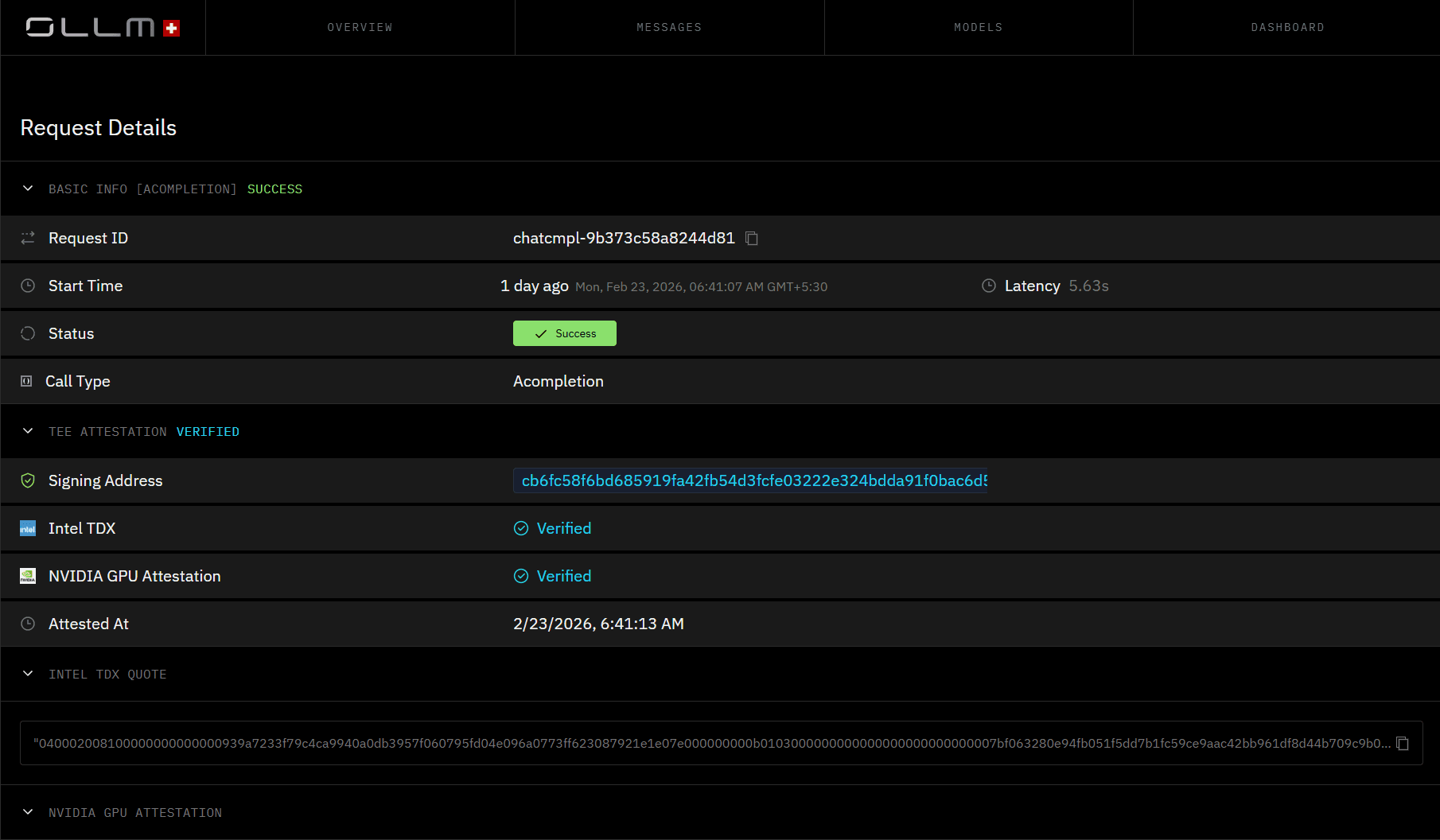
Model selection determines whether inference runs on standard infrastructure or inside a TEE via OLLM.
payload = { |
From a system design perspective, this creates a single security boundary. It does not matter which model handles the request; the data path remains identical. This becomes important in multi-tenant systems. Imagine a SaaS platform where different customers trigger different model paths based on the features they use.
Without a unified boundary, one tenant’s data might pass through a less isolated path simply because a feature uses a different model. That is a hard bug to detect, and harder to explain during an audit.
With ORGN, the isolation guarantee is attached to the gateway, not the model. That simplifies reasoning about the system. There is also an operational benefit. Security reviews no longer need to track model-specific behavior. The question shifts from “which model is safe” to “is the gateway configured correctly,” which is a smaller and more verifiable surface.
This does not remove all risk. Input data still originates outside the enclave, and outputs may still be stored in downstream systems. What it does is eliminate variation within the execution layer, where most unintended exposure tends to occur.
Full Workspace Confidential Compute
Securing only the model call leaves most of the pipeline exposed. In real systems, data is loaded, cleaned, transformed, and sometimes joined with other datasets before it ever reaches the model.
A typical internal workflow looks like this:
data = load_internal_data() |
Each function here touches sensitive data in memory. If only llm.generate runs inside a TEE, everything before it remains visible to the host system.
ORGN runs the full workspace inside confidential compute by default, rather than limiting isolation to model inference. The runtime executing load_internal_data, preprocess, and build_features also runs inside the enclave.
The effect is subtle but important. Data enters the workspace, gets decrypted inside the enclave, and does not leave that boundary in plaintext unless explicitly written out. Intermediate states do not leak into host-level memory, logs, or debugging tools.
This becomes more relevant in pipelines that combine AI with business logic. Consider a fraud detection flow that mixes rules and model output:
transactions = load_transactions(user_id) |
The filtering step already exposes high-value transactions. If that runs outside confidential compute, the sensitive part leaks before the model is even called.
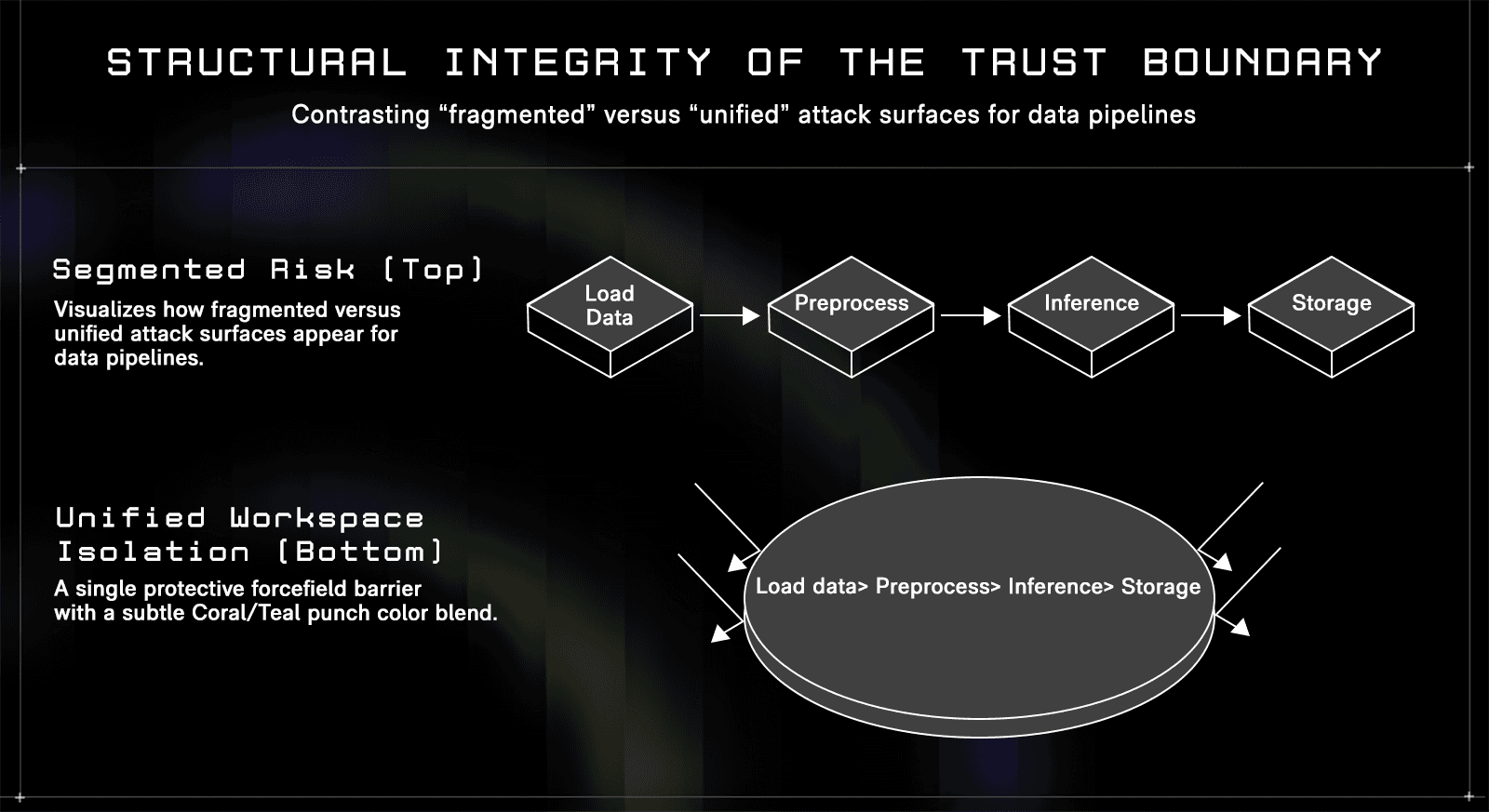
Because all workspaces run inside a TDX Sandbox by default, both rule-based logic and model inference operate within the same TEE boundary. This removes the need for developers to manually decide which steps require protection. Standard compute remains available for less sensitive workloads. Teams can choose when to apply full workspace isolation, rather than enforcing it across every pipeline and incurring unnecessary overhead.
Attestation and Trust Verification
Isolation is only useful if it can be verified. A TEE without attestation is just a claim. ORGN supports remote attestation, which allows clients to confirm that a workload is running inside a genuine enclave with expected measurements. This includes validating the enclave identity, the loaded code, and the hardware-backed signature that proves the execution environment has not been altered.
In practice, developers do not work with raw attestation artifacts such as low-level enclave reports. For OLLM confidential model sessions, ORGN surfaces attestation at the request level, where each execution can be tied to a verified enclave. This status is exposed through the platform interface and associated metadata, so teams can confirm that a request was processed in a trusted environment.
The underlying mechanism still relies on CPU-generated measurements that represent the exact code and configuration loaded into the enclave. This matters in distributed systems, where the same API could otherwise run on an untrusted or misconfigured node without being detected.
With attestation, trust becomes enforceable. Systems can ensure that only verified environments handle sensitive workloads, and any deviation can be detected without relying on external audits or vendor claims.
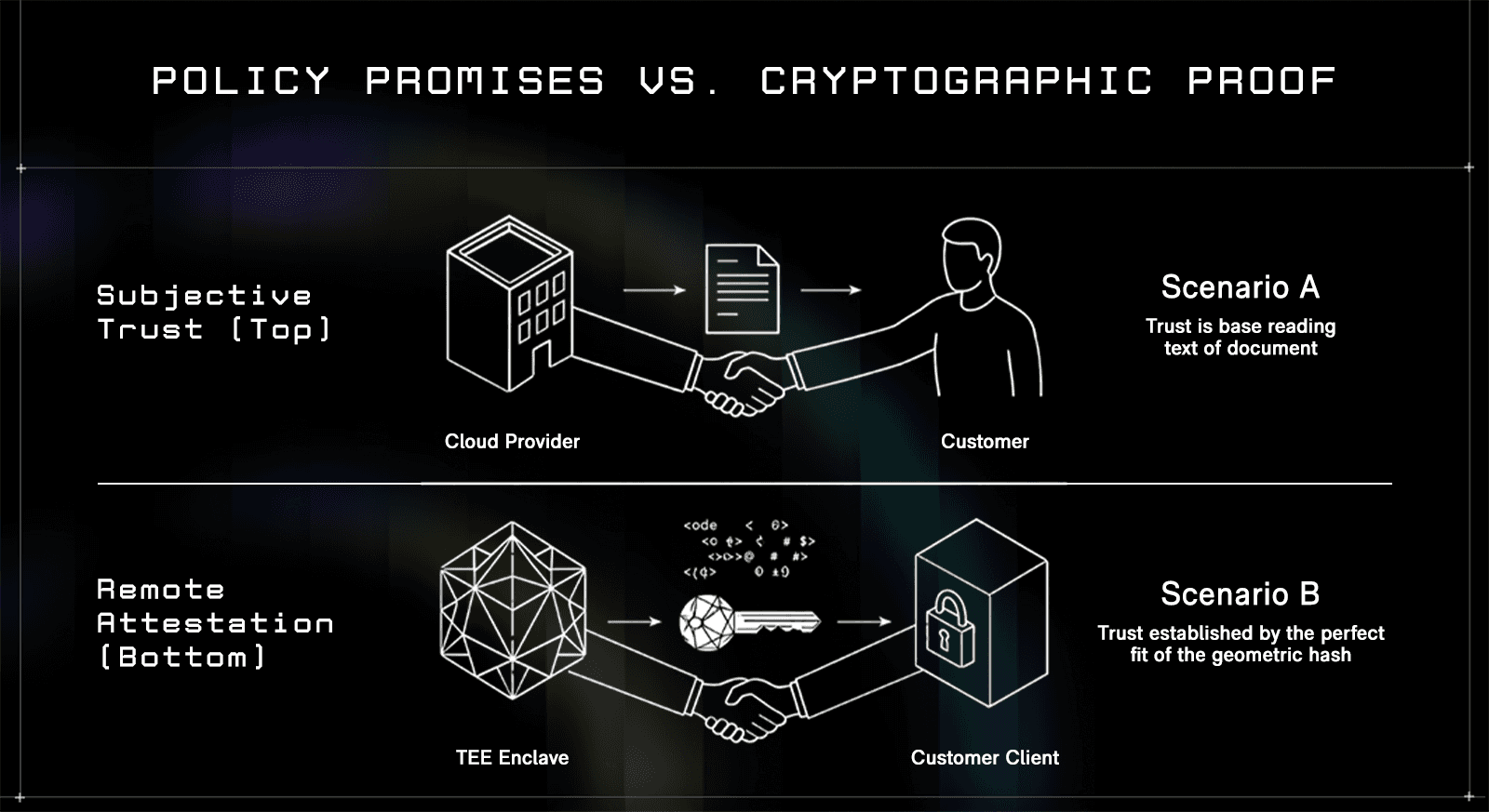
This shifts security checks from periodic reviews to runtime guarantees. Instead of validating infrastructure after deployment, teams can confirm the execution environment as part of each request lifecycle.
No Retention, No Debug Backdoors
A large part of the risk in AI systems comes from elements not on the main execution path. Logging, tracing, retry queues, and fallback storage often capture data that engineers never intended to persist.
Take a common pattern where teams enable request logging to debug production issues:
def generate_response(prompt): |
This looks harmless during development. In production, it means that every prompt, including internal documents or user data, is written to logs that may persist for weeks or months.
Even when teams disable explicit logging, observability tools often capture request payloads or partial traces. A failed request might end up in a retry queue, which becomes another storage layer for sensitive data.
ORGN avoids this class of problems by removing retention at the infrastructure level. When using OLLM confidential models, execution happens inside encrypted memory, so there is no access point for host-level logging systems to capture raw data. If a developer wants to persist something, they must explicitly write it outside the enclave. This changes how debugging works. You cannot attach a debugger to inspect memory inside a TEE, nor can you dump process state to understand failures.
Teams shift toward controlled observability patterns. Instead of logging raw inputs, they log derived signals:
def generate_response(prompt, trace_id): |
This approach keeps debugging useful while keeping the underlying data hidden. You track behavior, not content.
A more realistic workflow shows how this applies in a multi-step pipeline:
def process_document(doc_id, trace_id): |
The document content never leaves the enclave in plaintext. Logs only record identifiers and status, which are safe to persist.
This design forces discipline. Engineers cannot rely on dumping the state when something breaks. They must design workflows with explicit checkpoints and reproducible inputs. It is inconvenient at first, but it removes an entire category of accidental data exposure.
Performance Trade-offs and Practical Limits
Confidential computing introduces real constraints, and ignoring them leads to poor system design. Memory encryption and enclave isolation add overhead, typically manifesting as increased latency and lower throughput compared to standard execution.
In ORGN, this difference is not exposed through separate SDKs or clients. Both standard and TEE-backed execution use the same API endpoint, and the behavior depends on the selected model alias. Some models are configured to run inside TEEs, while others are not.
A typical request looks like this:
import requests |
TEE-backed execution involves encrypted memory access and restricted optimization paths, which can increase response time. The exact impact depends on hardware support, model size, and workload characteristics, but it is not negligible for latency-sensitive systems.
Memory limits are another constraint. TEEs have bound secure memory regions, which can restrict large models or data-heavy workloads. Some systems use paging or partitioning, but that introduces additional overhead.
Consider a pipeline that processes large datasets before inference:
data = load_large_dataset() |
If the dataset does not fit within enclave limits, the system must process it in chunks. This increases execution time and adds complexity around state management. ORGN abstracts some of these constraints, but they still exist at the hardware layer. Teams need to decide where a confidential compute is necessary.
A practical approach is to isolate only the pipeline's sensitive parts. For example:
data = load_public_data() |
Public or non-sensitive preprocessing can run in standard compute, while the sensitive inference step runs inside a TEE.
In more advanced setups, teams split workflows explicitly:
def public_stage(data): |
This pattern reduces overhead while still protecting critical data. Running everything inside a confidential compute is possible, but it slows down pipelines that do not need that level of isolation. The goal is not maximum isolation everywhere, but correct isolation where exposure risk exists.
Engineers already make similar trade-offs with encryption, caching, and replication. Confidential computing adds another dimension, runtime isolation, and it needs the same level of deliberate design.
Where It Is Important in Real Systems
Confidential computing becomes relevant when data exposure has real consequences rather than just theoretical risk. The pattern appears in systems that include regulated, contractual, or multi-tenant information in their runtime data.
Take a financial reporting workflow. A system aggregates internal ledgers, applies transformations, and generates summaries for analysts:
ledger = load_ledger(company_id) |
The sensitive part is not only the final report. The raw ledger and normalized data sit in memory during processing. If this runs on shared infrastructure without isolation, that data is exposed during execution. Confidential compute ensures that both transformation and generation happen inside the enclave. The ledger never exists in plaintext outside that boundary, which matters for compliance audits and internal controls.
Healthcare systems show a similar pattern. A pipeline might process patient records and generate summaries for clinicians:
records = load_patient_records(patient_id) |
Patient data is regulated, and exposure during processing constitutes a breach. Encrypting storage and transport is not enough if memory remains accessible. Multi-tenant SaaS systems face a different problem. Isolation must hold across tenants, even when they share infrastructure.
A support analytics feature might process data from multiple customers:
tickets = load_tenant_tickets(tenant_id) |
If execution is not isolated, one tenant’s data could be exposed through shared memory or misconfigured logging. Confidential computing enforces isolation at the hardware level, not through application logic.
Internal pilots also benefit from this model. These systems often index internal documentation, incident reports, and design discussions:
docs = load_internal_docs(team_id) |
The risk here is subtle. Even if outputs are safe, the context used for generation may contain sensitive design details or operational data. In all these cases, the pattern is the same. Data becomes vulnerable during execution, not just storage or transport. Confidential computing addresses that exact stage.
Comparison: Traditional AI APIs vs ORGN Confidential Execution
The difference between a standard AI API and ORGN’s confidential execution model is not visible in the interface. It appears in how data is handled during runtime.
Here is a direct comparison:
Aspect | Traditional AI APIs | ORGN Confidential Execution |
Data handling during execution | Decrypted in host memory | Decrypted only inside TEE |
Memory visibility | Accessible to OS, hypervisor, and tooling | Encrypted and isolated from the host |
Logging and retention | Often enabled or partially disabled | No access to raw data outside the enclave (OLLM confidential models) |
Multi-tenant isolation | Logical isolation through software | Hardware-enforced isolation |
Debugging approach | Full access to runtime memory and logs | Restricted, metadata-based observability |
Trust model | Based on vendor guarantees and policies | Based on hardware attestation |
Model consistency | Varies across providers and endpoints | Uniform for OLLM confidential models; standard models vary by provider |
Attack surface | Includes host system and observability stack | Limited to the enclave boundary |
The table shows structural differences, but the impact becomes clearer in workflows. In a traditional setup, a debugging session might involve inspecting request payloads or dumping memory to understand the cause of failures. That approach exposes sensitive data by design.
With ORGN, debugging relies on controlled signals. Engineers track execution through metadata and reproducible inputs rather than inspecting raw data. This reduces visibility but also removes accidental exposure paths. Another difference appears in audits. Traditional systems require reviewing logs, configurations, and vendor policies to understand how data is handled. The guarantees are indirect. With confidential execution, the system can verify its own state through attestation. The question shifts from “what does the provider claim” to “what does the hardware enforce.”
This does not remove all responsibility from application design. Data can still leak through outputs or downstream storage if handled incorrectly. It does change the core assumption. Instead of trusting that runtime environments behave correctly, the system enforces that behavior at the execution level.
Conclusion
Confidential computing shifts the trust boundary from software controls to hardware-enforced isolation, thereby changing how sensitive AI workloads are designed and deployed. This article walked through that gap using real pipelines, from simple prompt generation to multi-step workflows involving retrieval, preprocessing, and model inference, where sensitive data exists long before and after the model call.
ORGN addresses this by moving execution itself into a Trusted Execution Environment, covering both the AI Gateway and full workspace runtime. When using OLLM confidential models, prompts, intermediate transformations, and model outputs remain within encrypted memory, with no host-level visibility and no implicit retention in logs or observability systems. The system also enforces trust through attestation, so clients can verify that execution happens inside a valid enclave rather than relying on vendor claims.
The trade-offs remain real, including latency overhead, memory limits, and stricter debugging constraints, but they are predictable and can be designed around. In return, teams get a system where data exposure is not an accidental byproduct of runtime behavior. It becomes a deliberate choice, controlled at the boundary where execution happens, which is where most modern AI systems still fail.
FAQs
1. What is confidential computing, and how does it work?
Confidential computing protects data during execution by running workloads inside Trusted Execution Environments. These environments encrypt memory and restrict access so the host system cannot inspect or modify data while it is being processed.
2. What is a Trusted Execution Environment (TEE)?
A TEE is a secure area within a CPU that isolates code and data from the rest of the system. It ensures that even the operating system or hypervisor cannot access what runs inside it.
3. Why is confidential computing important for AI workloads?
AI systems process sensitive data such as prompts, embeddings, and outputs directly in memory. Confidential computing prevents data from being exposed at runtime, which traditional encryption does not.
4. What is the difference between confidential computing and encryption?
Encryption secures data at rest and in transit, while confidential computing extends protection to data in use. It ensures that data remains protected even as it is processed within the system.