" height="40.0000004693602px" id="JNsUwfViG" width="56px"/></svg>)
[
]
Data Sovereignty in the Age of AI Development
AI data sovereignty requires verifiable control, not just location—using TEEs, attestation, and zero-retention to secure prompts, outputs, and workflows.
Security & Compliance
Data sovereignty and data residency are not the same thing; residency asks where the servers are, while sovereignty asks whose laws govern the data and who holds practical control over it, a distinction that becomes critical when AI inference, prompt content, and model outputs introduce exposure surfaces that traditional frameworks weren't designed for.
AI development creates three data sovereignty risks that conventional governance frameworks miss: prompt content sent to third-party inference infrastructure, model outputs that can reflect patterns from regulated data, and agentic workflows that autonomously access regulated data across multiple systems without per-action human authorization.
Satisfying data sovereignty in an AI development environment requires five specific technical properties: hardware-level execution isolation via TEEs, cryptographic attestation of compliant execution, user-controlled data persistence where nothing is retained unless the user chooses it, zero-trust agent architecture with least-privilege permissions, and hardware-enforced data lifecycle controls. Most AI development tools satisfy none of these at the technical level.
Policy-based security, terms of service, compliance certifications, and "do not train" clauses are not equivalent to verifiable security. A policy is a promise about behavior that can be violated by misconfiguration, legal compulsion, or infrastructure compromise. Cryptographic attestation, backed by Intel TDX and NVIDIA GPU Attestation for model requests sent to OLLM, provides mathematical proof that a specific workload ran in a verified, isolated environment, independently verifiable by anyone with access to the attestation record.
ORGN is built around these requirements as architectural foundations rather than compliance additions, with TEE-backed execution via Intel TDX across all workspaces, Intel TDX and NVIDIA GPU Attestation for model requests routed through OLLM, user-controlled data persistence where nothing is retained unless the user chooses it, and isolated execution environments that give privacy-conscious developers and regulated teams proof rather than promises that give privacy-conscious developers and regulated teams proof rather than promises.
Data sovereignty used to be a compliance checkbox, something legal teams handled by confirming which country the servers sat in. AI has made that framing obsolete. When an engineering team sends proprietary code to a third-party model, asks an agent to refactor a payment service, or runs inference on customer data, the question of who controls that data and under whose legal authority it falls becomes immediate and consequential. Regulators have noticed. The GDPR, EU AI Act, HIPAA, and a growing body of national data localization laws now apply to AI inference and model outputs, not just to stored data.
For individual developers and engineering teams in regulated industries, this creates a specific problem. The AI development tools most teams reach for, cloud-hosted coding assistants, third-party model APIs, and shared inference infrastructure, were not designed with data sovereignty as a primary constraint. They were designed for speed. The gap between what those tools offer and what a fintech, healthcare, or defense team actually needs to satisfy a data sovereignty audit is where most AI adoption in regulated industries stalls. This article breaks down what data sovereignty actually requires in the context of AI development, where conventional tools fall short, and what a development environment built around those requirements looks like in practice.
Data Sovereignty and Data Residency Are Not the Same Thing
Data residency and data sovereignty are often used interchangeably, but they describe distinct concerns, and confusing them can lead to compliance gaps that only surface during an audit.
Data residency is a physical question: where are the servers? A data residency requirement is satisfied when data is stored and processed within a specific geographic boundary, a country, a region, or a designated data center. It's relatively straightforward to verify and has been the standard framing for cloud compliance for the past decade.
Data sovereignty goes further. It asks whose laws apply to this data and who holds practical control over it, regardless of where the servers are physically located. A company can store data in a European data center and still be subject to US law if the infrastructure provider is a US-headquartered company subject to the CLOUD Act. The servers are in the right country. The data is not sovereign.
The distinction matters especially for AI workloads because inference introduces new exposure surfaces that traditional residency frameworks weren't designed for:
Concern | Data Residency Addresses | Data Sovereignty Addresses |
Where data is stored | Yes | Yes |
Which laws govern access | No | Yes |
Who can compel disclosure | No | Yes |
What happens to prompt content during inference | No | Yes |
Whether model outputs reflect regulated data patterns | No | Yes |
Cryptographic proof of compliant execution | No | Yes |
For engineering teams building on AI, satisfying data residency is necessary but not sufficient. A model hosted in the right region can still process prompts on shared infrastructure accessible to the provider, log session content by default, and produce outputs that regulators increasingly treat as derived from regulated data. Data sovereignty requires controlling all of that, not just the geography.
Why AI Development Creates Data Sovereignty Risks
Traditional data governance was designed for data at rest and data in transit. Both are well-understood problems with established technical controls, encryption at rest, TLS in transit, and access controls on storage. AI development introduces three exposure surfaces that most governance frameworks weren't built to handle.
The prompt content sent to the third-party inference infrastructure poses the most immediate risk. When a developer sends a code snippet to a cloud-hosted model, asks an agent to refactor a payment service, or runs a debugging session against production logic, that prompt content travels to infrastructure the development team doesn't control, can't inspect, and can't verify. Contractual "do not train" clauses offer some legal protection, but, as TechTarget notes, some jurisdictions don't recognize them, and legal protection isn't the same as a technical guarantee that the data wasn't accessed or retained.
Model outputs that reflect patterns from regulated data are a subtler but increasingly scrutinized risk. Regulators, particularly under the EU AI Act, are imposing requirements on AI-generated outputs, not just on input data, on the basis that outputs can implicitly reveal patterns learned from sensitive training data. For teams working with financial records, patient data, or classified information, this means that the output of an AI session can carry regulatory weight even when the underlying data was never transmitted directly.
Agentic workflows operating across multiple systems autonomously compound both risks. An agent that reads a database schema, queries an API, modifies configuration files, and commits code to a repository touches regulated data across multiple surfaces in a single session. Traditional governance models assume a human is making each data access decision. Agentic systems remove that assumption, and most governance frameworks have no mechanism to audit what an autonomous agent accessed, in what sequence, or under what authorization.
The regulatory pressure driving these concerns is accelerating. The key frameworks engineering teams in regulated industries need to account for are:
GDPR: applies to AI inference and model outputs involving EU residents' data, not just stored records
EU AI Act: imposes transparency, auditability, and risk management requirements on AI systems used in regulated contexts
HIPAA: extends to AI processing of protected health information regardless of whether the output directly contains PHI
US CLOUD Act: allows US authorities to compel disclosure of data held by US-headquartered providers regardless of where that data physically resides, creating direct tension with GDPR for teams using US cloud providers
National data localization laws: India's DPDPA, China's PIPL, and a growing body of country-specific requirements impose increasingly strict controls on cross-border data flows
The practical implication is that for regulated teams, the compliance question isn't just "where is our data stored?" It's "what happens to our code and prompts during inference, who can access that infrastructure, what evidence exists of compliant execution, and what data persists after the session ends?" Most AI development tools have incomplete answers to all four questions.
What Data Sovereignty Actually Requires from an AI Development Environment
Translating data sovereignty requirements into technical infrastructure means going beyond policy statements and contractual assurances. Each requirement maps to a specific technical capability, and the gap between a tool that claims to satisfy it and one that can prove it is exactly where regulated teams get caught in audits.
Hardware-level execution isolation is the foundational requirement. Processing code and prompts on shared cloud infrastructure, even with encryption in transit, means the inference environment is accessible to the infrastructure provider and potentially vulnerable to co-tenant side-channel or isolation-failure vectors on shared hardware. Satisfying data sovereignty at the execution layer requires Trusted Execution Environments: hardware-isolated enclaves where memory is encrypted and inaccessible to the host OS, the cloud provider, and other tenants, regardless of what happens at the software layer above.
Cryptographic proof of compliant execution is what separates verifiable security from policy-based security. Most tools offer assurances, terms of service, compliance certifications, and audit reports. What regulated industries increasingly require is attestation: cryptographic evidence that a specific workload ran inside a verified, unmodified execution environment with expected integrity. That evidence can be validated independently, exported into an existing security stack, and presented to an auditor as proof, not a promise.
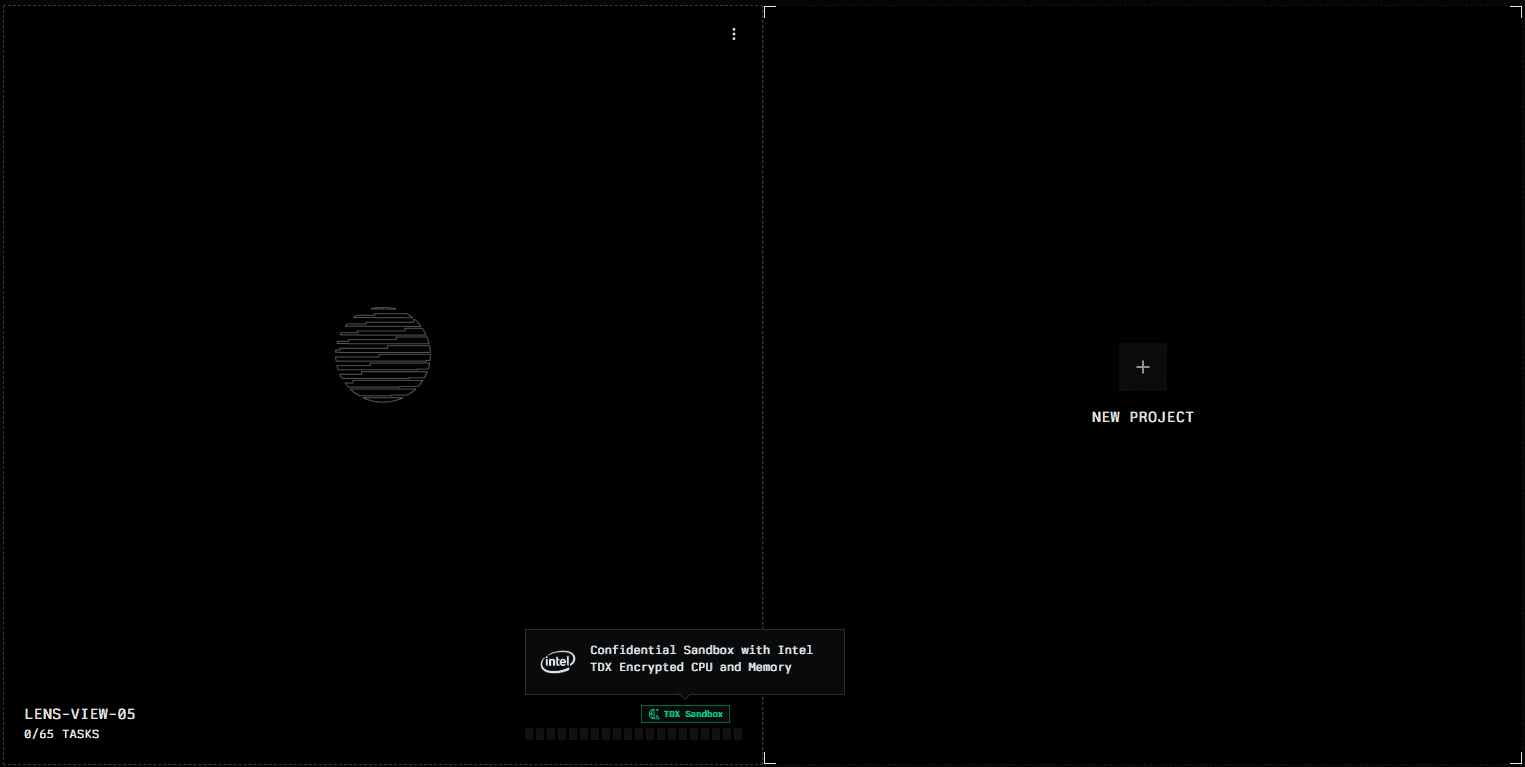
User-controlled data persistence closes the breach surface that policy alone can't close. In ORGN, nothing is retained unless the user actively chooses it. All data sits inside a TDX-encrypted sandbox throughout its lifecycle, meaning even retained data is inaccessible to anyone other than the user. For OLLM confidential models specifically, no prompts, code, or outputs are stored or used to train AI models. The distinction matters structurally: controlling what persists and encrypting what does removes the attack surface rather than just protecting it, there is no recoverable data for a compromised infrastructure to expose.
Zero-trust agent architecture addresses the problem of agentic workflow. Every agent and tool that touches regulated data needs to authenticate with a unique identity, operate under least-privilege permissions scoped to the specific task, and produce a complete, auditable record of every action taken. The alternative, agents with broad permissions operating without granular authorization, creates exactly the kind of unaudited data access that sovereignty frameworks are designed to prevent.
Together, these requirements form a coherent picture of what a data-sovereign AI development environment looks like:
Requirement | What It Means in Practice |
Hardware-level execution isolation | TEE-backed inference, code, and prompts processed in encrypted enclaves inaccessible to the host or provider |
Cryptographic attestation | Verifiable proof that the workload ran in an expected, unmodified environment, exportable to your security stack |
User-controlled data persistence | Nothing retained unless the user chooses it; TDX-encrypted throughout the lifecycle; OLLM confidential models specifically produce no stored prompts, code, or outputs |
Zero-trust agent architecture | Agents authenticate with unique identities, operate under least-privilege permissions, and all actions are logged |
Most AI development tools satisfy none of these at the technical level. They offer policy-based equivalents, terms of service that promise isolation, certifications that attest to processes, and default settings that can be changed. For teams subject to external audit, the distinction between a policy and a proof is between a compliant deployment and a failed one.
How ORGN's Architecture Addresses the Technical Requirements
ORGN is a Confidential Development Environment (CDE) and Agentic Development Environment (ADE) built specifically for teams where verifiable security isn't a preference, it's a hard requirement. Where most AI development tools ask regulated teams to accept policy-based assurances, ORGN is architected around the technical requirements laid out in the previous section: hardware-level isolation, cryptographic proof of execution for OLLM-routed confidential inference, and user-controlled data persistence.
OLLM is the foundation. ORGN's proprietary unified AI gateway sits between the development environment and the underlying models, exposing a single API that routes requests either to standard models for everyday work or to models running inside Trusted Execution Environments when confidentiality is required. When a TEE-enabled model is selected, the request is routed to a secure TEE-backed execution environment where memory is encrypted and inaccessible to the host, other tenants, and ORGN itself. Model selection is explicit at the application layer; the gateway handles execution policy, including load balancing, fallback, and rate-limit-aware routing across deployments, depending on configuration.
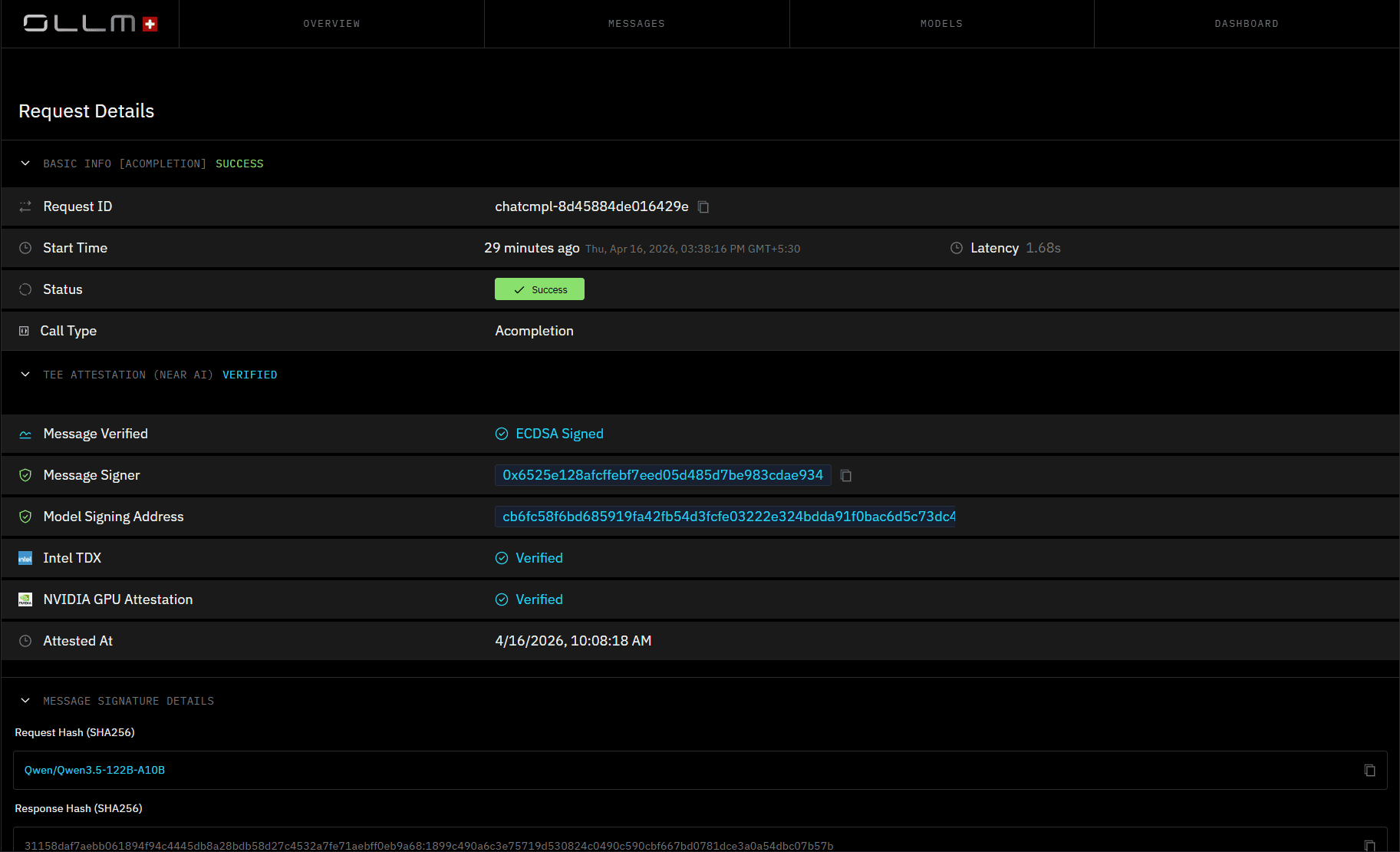
For model requests routed to OLLM models, both Intel TDX and NVIDIA GPU Attestation are verified per request. Intel TDX provides CPU-level isolation through encrypted virtual machine domains, and NVIDIA GPU Attestation extends that verification to GPU workloads. Together, they produce cryptographic attestation records, visible and retrievable in the OLLM console, that prove the workload ran inside a verified enclave with expected integrity. These records are independently verifiable by anyone with access to them, not a claim that depends on trusting the provider.
Data persistence is user-controlled. Nothing is retained unless the user chooses it. Worktree data follows a defined lifecycle before teardown, and users can trigger immediate teardown at any time by archiving and deleting their worktree. Throughout that lifecycle, all data sits inside a TDX-encrypted sandbox, meaning even retained data is encrypted at the hardware level and inaccessible to anyone other than the user. For OLLM confidential models specifically, no prompts, code, or outputs are stored or used to train AI models at any point, except for operational metadata such as token counts needed for billing.
Isolated execution scopes every task in its own session-bound environment, reducing the risk of lateral movement and containing misconfigured agents. Combined with a zero-trust agent architecture, in which agents authenticate with unique identities and operate under least-privilege permissions, this means every action an agent takes against regulated code or data is authorized, observable, and logged, not assumed to be safe simply because it originated from an approved tool.
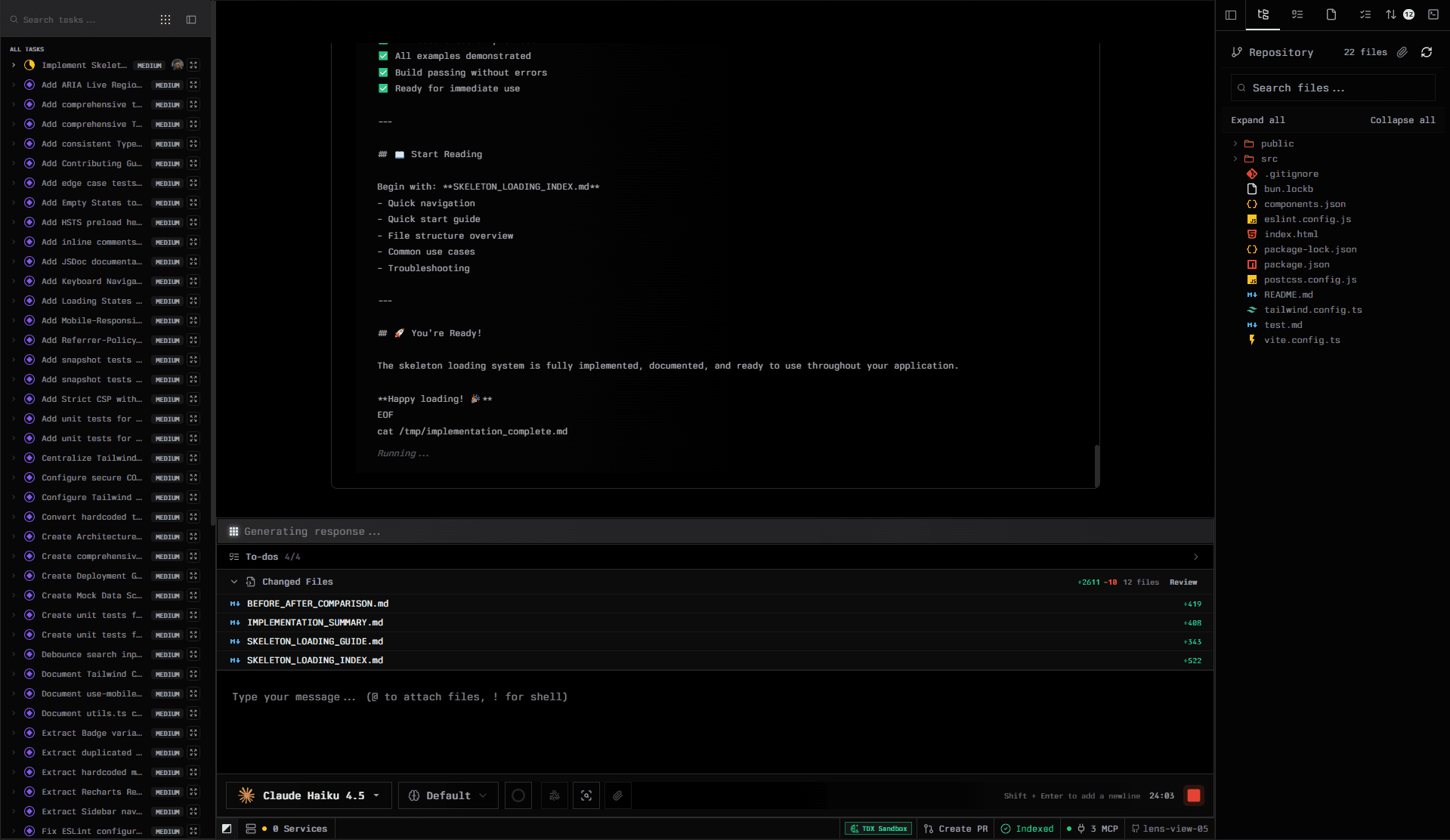
Scaling is handled through monthly and annual plans that match current usage needs. For teams expecting usage growth or approaching capacity limits, reserved capacity is available through sales, useful when shipping deadlines create demand spikes that need to be planned for in advance. Multiple agentic sessions can run asynchronously on the same task without blocking human work or losing observability, so scaling is about parallelism as much as raw throughput.
The result is a development environment where verifiable security isn't a compliance layer bolted onto a tool designed for something else; it's the architectural foundation on which the tool was built. For regulated teams, that distinction is what makes AI-assisted development approvable rather than just desirable.
Why Policy-Based Security Is Not Enough for Regulated AI Development
Every major AI development tool on the market makes security commitments. Terms of service promise data isolation. Compliance certifications attest to security processes. Enterprise agreements include "do not train" clauses. For many use cases, these assurances are sufficient. For regulated industries, they aren't, and understanding why requires being precise about what a policy actually guarantees versus what cryptographic proof guarantees.
A policy is a promise about behavior. When a cloud provider says your data is isolated, they mean their systems are configured to keep it that way, and their employees are contractually bound not to access it. That promise can be audited, and third parties can verify that the processes described in the policy are in place. But it cannot be verified at the moment of execution. If the infrastructure is misconfigured, compromised, or subject to a legal compulsion order, a US CLOUD Act request, for example, the policy offers no technical protection. The data was accessible. The promise just said it wouldn't be accessed.
Cryptographic attestation is a proof of execution. When a model request is sent to OLLM, the execution environment produces an attestation record backed by both Intel TDX and NVIDIA GPU Attestation, generating cryptographic evidence that a specific workload ran inside a specific, unmodified enclave with expected integrity at a specific point in time. That evidence is mathematically verifiable; it doesn't depend on trusting the infrastructure provider's processes, their employees' behavior, or their legal obligations to a foreign government. An auditor can independently validate the attestation report and confirm that the execution environment was as it claimed.
The practical difference looks like this:
Security Claim | What It Guarantees | Who Can Verify It |
"We don't access your data" | A contractual commitment | Third-party auditors reviewing processes |
"We are SOC 2 compliant" | Security controls were in place at audit time | Auditors at the point of certification |
"Do not train" clause | Legal protection in jurisdictions that recognize it | Lawyers, not engineers |
TEE cryptographic attestation | The workload ran in an isolated, verified environment | Anyone with the attestation record |
For teams subject to GDPR, HIPAA, or financial services regulation, the question an external auditor asks is not "do you have a policy about this?" It's "can you prove it?" A compliance certification answers the first question. A cryptographic attestation record answers the second.
User-controlled data persistence compounds this distinction. A policy that says prompt content isn't stored is a commitment that can be violated by a misconfiguration, a logging change, or a legal order. An architecture where all data sits inside a TDX-encrypted sandbox throughout its lifecycle, and where OLLM confidential models specifically produce no stored prompts, code, or outputs, removes the attack surface structurally rather than protecting it by promise. There is no prompt database subject to legal compulsion, and the hardware-level encryption means the retained data is inaccessible to anyone other than the user. The technical architecture is the protection, not a vendor commitment about how data is handled.
This is why the gap between tools that offer policy-based security and environments that offer verifiable security is not a feature gap. It's an architectural one. For regulated teams, it's also the difference between a tool their security team can approve and one that stalls in procurement, regardless of how fast it makes developers.
Data Sovereignty Is an Infrastructure Problem, Not a Policy Problem
Satisfying data sovereignty requirements in AI development isn't achieved through better terms of service, stricter vendor agreements, or more thorough compliance certifications. It requires building the right infrastructure from the ground up: hardware-level execution isolation, cryptographic proof of what ran and where, and user-controlled data persistence, with nothing retained unless the user actively chooses it.
For engineering teams in fintech, healthcare, defense, or any regulated sector navigating this landscape, the practical question is straightforward: can you prove to an external auditor that your AI development environment meets these technical requirements, or are you relying on policy assurances that don't hold up under scrutiny? ORGN is built for teams that need to answer yes to that question: individual developers who won't accept proprietary code on shared infrastructure, and regulated teams in fintech, healthcare, and defense who need cryptographic proof rather than policy promises. With TEE-backed execution via Intel TDX across all workspaces, Intel TDX and NVIDIA GPU Attestation for model requests routed through OLLM, user-controlled data persistence, and isolated execution environments, the technical properties that regulated teams need to meet their own data sovereignty obligations are enforced at the infrastructure level rather than dependent on vendor commitments. Get started at orgn.com.
Frequently Asked Questions
What is the difference between data sovereignty and data residency in AI development?
Data residency is a physical question; it asks where data is stored and processed, and is satisfied when infrastructure sits within a specific geographic boundary. Data sovereignty goes further: it asks whose laws govern that data and who holds practical control over it, regardless of where the servers are located. For AI development, the distinction matters because a model hosted in the right country can still process prompts on infrastructure subject to foreign legal jurisdiction. The US CLOUD Act, for example, allows US authorities to compel disclosure of data held by US-headquartered providers regardless of physical location. Satisfying data residency is necessary but not sufficient for regulated teams.
What does the EU AI Act require from AI development environments used in regulated industries?
The EU AI Act imposes transparency, auditability, and risk-management requirements on AI systems operating in high-risk contexts, covering not just stored data but also AI inference and model outputs. For development teams, this means AI-generated outputs involving regulated data can carry compliance obligations even when the underlying data was never directly transmitted. Practically, it requires that AI development environments produce auditable records of what ran, in what environment, and under what authorization, and that those records can be verified by external auditors rather than accepted on the provider's word.
How does OLLM route requests to TEE-backed execution environments, and what does that mean for data sovereignty compliance?
OLLM is ORGN's proprietary unified AI gateway that sits between the development environment and the underlying models. Model selection is explicit at the application layer. When a TEE-enabled model is selected, the request is routed to a secure TEE-backed execution environment where both Intel TDX and NVIDIA GPU Attestation are verified per request, memory is encrypted, and the execution environment is inaccessible to the host, other tenants, and ORGN itself. The gateway handles execution policy, including load balancing, fallback, and rate-limit-aware routing across deployments depending on configuration. Each confidential session produces cryptographic attestation records that can be validated independently or exported into an existing security stack.
How does ORGN handle data persistence, and why does that matter for teams with data sovereignty obligations?
ORGN gives users control over their data lifecycle; nothing is persisted unless the user chooses it. Worktree data follows a defined lifecycle before teardown, and users can trigger immediate teardown at any time by archiving and deleting their worktree. Throughout that lifecycle, all data sits inside a TDX-encrypted sandbox, meaning even retained data is encrypted at the hardware level and inaccessible to anyone other than the user. For teams using OLLM confidential models specifically, no prompts, code, or outputs are stored or used to train AI models at any point, except for operational metadata such as token counts needed for billing. This means there is no prompt database subject to legal compulsion, no configuration drift that accidentally retains what should have been discarded, and no recoverable session content for a compromised infrastructure to expose. These technical properties are enforced at the infrastructure level rather than relying on developers to remember to disable logging.
Why is cryptographic attestation more reliable than compliance certifications for proving data sovereignty?
Compliance certifications like SOC 2 attest that security controls were in place at the time of audit; they verify processes, not individual execution events. Cryptographic attestation backed by Intel TDX and NVIDIA GPU Attestation, for model requests sent to OLLM, generates mathematical evidence that a specific workload ran inside a specific, unmodified enclave with expected integrity at a specific point in time. That evidence is independently verifiable by anyone with the attestation record, doesn't depend on trusting the infrastructure provider's ongoing behavior, and holds up under direct regulatory scrutiny in a way that a certification issued months earlier cannot. For teams subject to external audit, attestation asks "can you prove it?", while certifications ask "do you have a policy about it?"